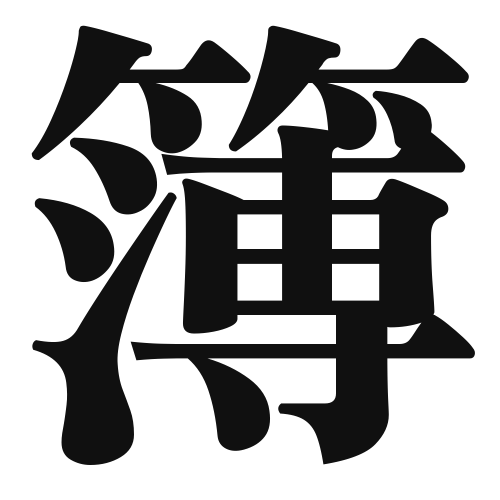
1. Overview of Meaning
The kanji “簿” (bo) primarily means “book” or “register.” It is often used in contexts related to accounting, records, and documentation.
2. Formation and Radical
Formation of the Kanji: The kanji “簿” is a phonetic compound (形声文字) that combines the radical for “bamboo” (竹) with a phonetic component that suggests its pronunciation.
Radical: The radical of “簿” is 竹 (take), which relates to bamboo, indicating that the original form of books or records may have been made from bamboo strips.
3. Examples of Usage
Common Words and Phrases: Some frequently used terms that include “簿” are:
- 帳簿 (ちょうぼ, chōbo) – ledger
- 簿記 (ぼき, boki) – bookkeeping
Example Sentences in Daily Conversation:
- 「新しい帳簿を買いました。」(I bought a new ledger.)
- 「簿記の勉強を始めました。」(I started studying bookkeeping.)
4. Synonyms and Antonyms
Similar Kanji: A similar kanji is “書” (しょ, sho), which means “to write” or “writing.” While “簿” refers specifically to books or records, “書” encompasses a broader range of written materials.
Antonyms: An antonym could be “消す” (けす, kesu), meaning “to erase” or “to delete,” as it represents the action of removing written records.
5. Cultural and Historical Background
Relation to Japanese Culture: The concept of keeping records is deeply rooted in Japanese culture, especially in business and administration. The use of “簿” reflects the importance of documentation in maintaining order and accountability.
Proverbs and Idioms: One relevant proverb is “帳簿をつける” (chōbo o tsukeru), which means “to keep records,” emphasizing the value of organization and accuracy in financial matters.