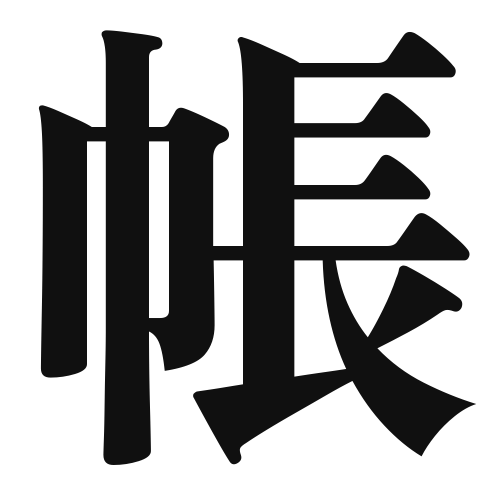
1. Overview of Meaning
The kanji “帳” (chō) generally means “book,” “register,” or “account.” It is often used in contexts related to records or documentation.
2. Formation and Radical
Formation of the Kanji: The kanji “帳” is a compound character (会意文字) that combines elements to convey its meaning. It consists of the radical for “cloth” (巾) at the top, which suggests something that covers or wraps, and the character “章” (shō) at the bottom, which relates to “sign” or “mark.”
Radical: The radical of “帳” is 巾 (kin), which is associated with cloth or fabric.
3. Examples of Usage
Common Words and Phrases: Some frequently used words that include “帳” are:
- 帳簿 (ちょうぼ, chōbo) – ledger, account book
- 帳面 (ちょうめん, chōmen) – notebook, register
Example Sentences in Daily Conversation:
- この帳簿は会社の売上を記録しています。
(This ledger records the company’s sales.) - 彼は毎晩、日記帳に出来事を書きます。
(He writes events in his diary every night.)
4. Synonyms and Antonyms
Similar Kanji: A similar kanji is “記” (ki), which means “to record” or “to write.” While “帳” refers to a physical book or register, “記” focuses more on the act of recording information.
Antonyms: An antonym could be “消” (shō), which means “to erase” or “to delete,” representing the opposite action of recording information.
5. Cultural and Historical Background
Relation to Japanese Culture: In Japan, “帳” is often associated with traditional practices of record-keeping, such as in temples and businesses. The use of account books has been a significant part of Japanese history for managing finances and resources.
Proverbs and Idioms: One common idiom is “帳簿をつける” (chōbo o tsukeru), which means “to keep accounts,” emphasizing the importance of maintaining accurate records in both personal and business contexts.